


Transforming Biosecurity
Biosocial Security: Social Science Transformations of Biosecurity BIOSSCI
Home | Where we are working | Team | Resources | News & Events | Contact Us
About
BIOSSCI is a European Research Council advanced project that seeks to transform how we think about and practice biosecurity. Making life safe involves many overlapping but sometimes competing demands. They include, reducing disease risks, ensuring animal health and welfare, working towards sustainable and fair food systems and promoting biodiversity.
Current approaches to biosecurity in farming and food production primarily focus on farm level disease risks. But increased infection pressures, climate change, different farming landscapes and mounting costs make existing approaches liable to fail. It’s a good time to explore alternatives.
To develop approaches that work more effectively we are:
- Working with farmers, animal health experts, policymakers and others to understand the challenges in securing animal health
- Identifying specific obstacles to improvement as well as accessible actions
- Developing a bio-diplomatic approach to highlighting common concerns and areas for collective agreement and action
Why this research matters
Infectious disease threats present a persistent global challenge, impacting human and animal health, food systems, and livelihoods.
These threats are becoming more intensive as a result of a range of issues that include: accelerated climate change, ecological degradation, extensive trade and travel, political uncertainty, rural impoverishment, growing livestock numbers, increased virulence and antimicrobial resistance.
Conventional, top-down, approaches to biosecurity have a mixed record. They are often difficult or impossible to implement, and they can have wider consequences for health, welfare and environment.
The need to transition to more sustainable food systems provides further challenges as well as an opportunity to address some of these rising challenges.
It is therefore vital that we:
- Redefine what is good biosecurity
- Develop bottom-up approaches to generating context-specific approaches
- Learn how to link those contexts in ways that are agreeable to all parties
Aims and Objectives
Aims
- To learn how biosecurity is practised and judged across various settings.
- To investigate whether and how these lessons can be accommodated with or incorporated into future policy formulations.
- To provide new concepts and tools for social science in its bid to understand relationships between knowledge, biological processes and the dysbiotic times in which we live.
We will achieve these aims by meeting the following objectives:
- Objective 1: Generate accounts of biosecurity and policy in action in three contrasting settings
- Objective 2: Analyse key tensions and conflicts in biosecurity practice
- Objective 3: Formulate and assess prospects for change in future biosecurity action
The Value of a Biosocial Approach
This is a social science-led project – but more accurately we are investigating the biosocial – a term that is frequently used to emphasise how biological and social interactions affect qualities of life.
We are using biosocial to emphasise the need to work across biological and social differences, or contexts, in ways that can generate greater safety and security.
Our work is shaped by and contributes to scholarship in Geography, Anthropology as well Science, Technology and Society (STS). Our concern is to show how and why these approaches matter to pressing biosocial problems.
Biosocial security involves dealing with multiple normativities, or various 'goods' and challenges. How to assemble those values and goods is a key area for social science experimentation and development.
Research Phases
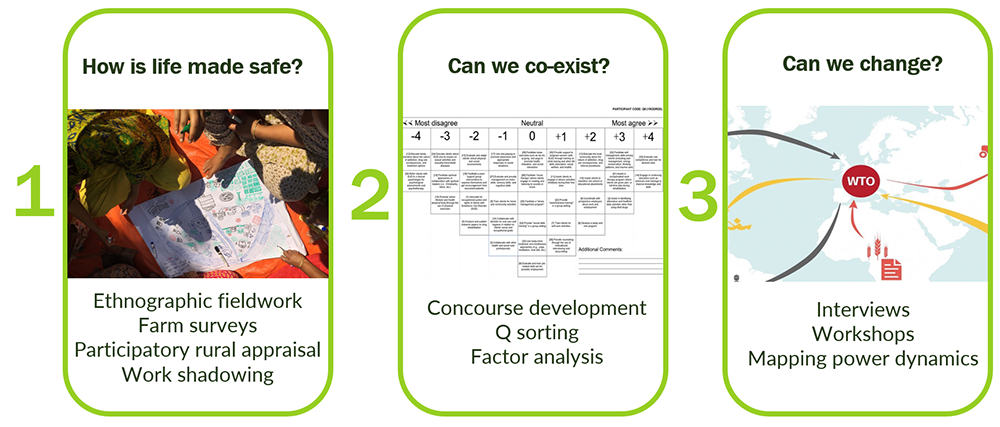
The research is organised into three phases: how is life made safe; can we coexist or live together with these approaches; and can we change our policies and methods?
Once we have learned how life is made safe, we need to investigate the extent to which possible solutions and methods work across landscapes and food systems.
We will use social science tools to identify key areas for policy development. Working bio-diplomatically, we will develop a Q-Method approach to identify key areas of agreement and foci for future action.
In the final phase we will work with national and international organisations to configure and develop biosocial security and assess its value as a policy tool.
Organisations
 |  |  |
Project Acknowledgment
This project is funded until 30 April 2031 by Horizon Europe ERC Grant number: 101200322

Project title and acronym: Biosocial Security: Social Science Transformations of Biosecurity (BIOSSCI)
Contact Us
School of Geography and the Environment
University of Oxford
OUCE, South Parks Road
Oxford, OX1 3QY
Email: Biossciproject@ouce.ox.ac.uk
LinkedIn: BIOSSCI LinkedIn
For maps and directions, please see the School of Geography and the Environment contact information.