
Professor David S.G. Thomas
Professor of Geography
Professorial Fellow of Hertford College, Oxford
Member of the Environment Research Doctoral Training Partnership
Professor of Geography
Professorial Fellow of Hertford College, Oxford
Member of the Environment Research Doctoral Training Partnership
Academic Profile
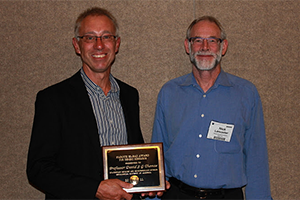
David Thomas is a geomorphologist and physical geographer specialising in contemporary drylands and the Quaternary Period. Much of his research has been carried out in Africa, but he also conducts research in Arabia, Asia, India, North America and other dryland contexts. His research has often been multi- and interdisciplinary. On the one hand he has led interdisciplinary projects on desertification, land degradation, sustainable land use and climate change impacts; on the other he works on projects focussed on geomorphological processes, Late Quaternary environmental change, climate change science and environmental-climate interactions, with archaeologists, biologists, climate scientists and other physical geographers. He has authored or edited 13 books, including The World Atlas of Deserts and Drylands (2024),The Dictionary of Physical Geography (4th edition 2016), Arid Zone Geomorphology (3rd edition 2011), The World Atlas of Desertification (2nd edition 1998), Desertification: exploding the myth (1995) and The Kalahari Environment (1991) and over 250 peer-reviewed journal papers and contributions to edited volumes including IPCC assessment reports. In 2011 David was awarded the Geological Society of America Farouk El-Baz Award, for a body of work that has significantly enhanced desert science, and in 2019 the Royal Geographical Society's Victoria Medal, for world leading research into dryland environments and societies. In 2025 he was awarded the David Linton Medal by the British society for Geomorphology, in recognition of his lifetime contribution to the discipline.
In 2004 David Thomas was elected Professor of Geography at Oxford and Professorial Fellow at Hertford College, holding the original statutory chair previously occupied by Andrew Goudie, Jean Gottmann, E.W.Gilbert and Kenneth Mason. He was Head of the School of Geography and Environment from 2007 to 2011. In 2024 he was elected to a Senior Research Fellowship at Hertford College. Prior to returning to Oxford, where he was a student from 1977-84 for undergraduate, Cert. Ed. and D.Phil degrees, David was at Sheffield University, rising from lecturer to Professor in the Department of Geography between 1984 and 1994, founding the Sheffield Centre for International Drylands research in 1994 (Director until 2004) and serving as Head of Department form 1997-2000. In 2006 he was appointed Honorary Professor at the University of Cape Town and in 2013 at the University of the Witwatersrand, both in South Africa.
In recent years he has been Vice-President of the Royal Geographical Society (for Research and Higher Education, 2013-16, and Fieldwork and Expeditions, 2002-5). In 2002-2005 he was chair of the British Geomorphological Research Group; when the group was re-established as the British Society for Geomorphology he was elected as one of the founding Fellows, in 2014. From 2014-16 he chaired the RGS International Benchmark Review of UK Physical Geography, and in 2013-14 chaired the Quality Assurance Agency (QAA) Geography Benchmark Statement review which increased the expectation for quantitative analysis and fieldwork in geography degree courses. He was a member of the RAE2008 and REF2014 Geography subpanels and has been a member of similar discipline and university sector reviews overseas. He subsequently chaired the REF2021 subpanel for Geography and Environmental Studies and was a member of Main Panel C. From 2011-14 he was a member of the UK Government Office for Science, Foresight Programme Lead Expert Group, 'Environmental drivers of migration' (final report).
Despite undertaking many internal university and external administrative and executive roles, as well as leading major research projects, David Thomas maintains a significant teaching and doctoral supervision profile and was for five years a member of the management committee of Oxford's NERC-DTP. To date he has supervised over 50 doctoral students to completion, including many now in their own, often senior, academic posts. These include Professors Andy Dougill (Dean of the Faculty of Sciences, University of York), David Nash (Brighton), Joanna Bullard (Loughborough), Lindsay Stringer (York), Jeremy Perkins (Botswana) and Laura Pereira (Witwatersrand). Drs Chasca Twyman (Sheffield), Andy Carr (Leicester), Brain Chase (CNRS Montpellier), Matt Telfer (Plymouth), Tom Stevens (Uppsala), Alex Arnell (Reading), Susannah Sallu (Leeds), Sallie Burrough (Oxford), Abi Stone (Manchester), Andrew Dansie (Sydney), Kaja Fenn (Liverpool) and Aayush Srivistava (St Andrew's) were also supervised by David.
Current Research
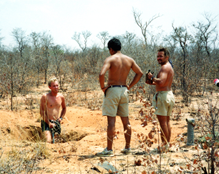
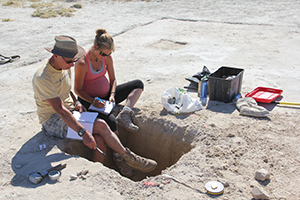
David Thomas has been PI or Co-I on research grants funded by RCUK (NERC and ESRC), The Leverhulme Trust, Fell and Boise Funds totalling almost £9million in value. Most projects employ rigorous fieldwork to generate empirical datasets from environmental contexts that are data-poor. , These data are then analysed with appropriate laboratory (including geochronology) methods; results are often then used in modelling contexts. Many field seasons have been spent working on Quaternary environmental change and aeolian process questions in and around the margins of deserts in Africa and other continents, with over 35 years spent working in the interior of southern Africa, especially in and around the extensive Kalahari region.
Quaternary Science- the Kalahari, Namib, Thar and Arabian Deserts… and beyond
It is difficult to establish how the world's extensive deserts and drylands have responded to past global climate changes, data that will inform us about potential responses to future climate changes. Many of the traditional Quaternary terrestrial proxy data sources available in other environments, especially those with biological origins, are not available in these dry systems, so we have extensively used geoproxy data (Thomas, 2013; Thomas and Burrough , 2012), from aeolian (dune) and lacustrine (lake shoreline) sediment sources, producing luminescence age records of sedimentary accumulation histories over timescales of up to 250ka. Long standing work in the Kalahari region (parts of Botswana, Namibia, South Africa, Zambia, Zimbabwe) (e.g. Stone and Thomas, 2008, Burrough and Thomas ,2008) has been followed by similar approaches in the Arabia deserts (Leighton et al., 2014), and now in the Thar Desert of India.
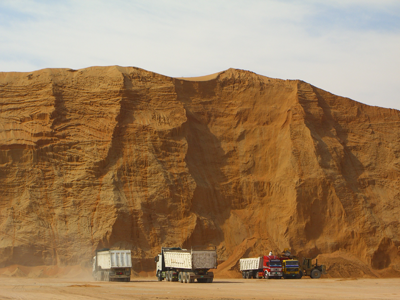
Dune data have contributed to models of potential 21st century dune dynamics in the Kalahari, (Thomas et al., 2005) and we are now exploring new modelling approaches to better interpret the timing and drivers of past desert dune accumulation (Bailey and Thomas, 2013). New approaches are also being tested for extracting geochemical records of long term climate and environmental change from the extensive dry lake systems of the Kalahari, since this desert has not only had geographically extensive active dune systems in the past, but has also supported megalakes up to 60,000ka2 in size. (Burrough, Thomas & Bailey, 2009).
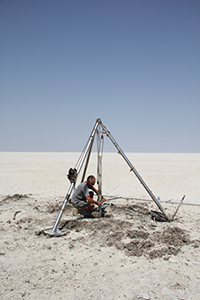
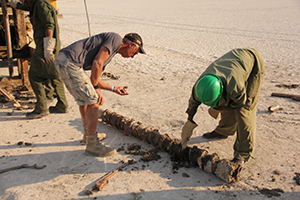
Sedimentological and geochronometric work in southern Africa is also being extended to Quaternary fluvial valley deposits in Namibia, which offer the potential to understand the nature and timing of fluvial dynamics within the world's driest desert region. We are also exploring ways to use luminescence dating to analyse dryland land surface responses to drought, working in Nebraska, as well as projects looking at improving knowledge on the origins and deposition timing of European loess.
Human responses to drylands- landscape archaeology in deserts
Deserts are full of evidence of the presence of early humans and even early civilisations. Environmental and climatic ('hydroclimate') dynamics in the past have made areas that appear inhabitable and inhospitable today more attractive for opportunistic and persistent human presence in the past. This theme is currently being investigated through collaborative research with archaeologists and palaeoscientists in two differing contexts: the landscape archaeology of the Kalahari of Botswana and the ancient Indus civilisation of the Thar Desert, while other research has occurred in the context of 'green Arabia' in the United Arab Emirates (Preston, Thomas et al., 2015).
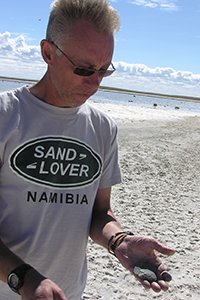
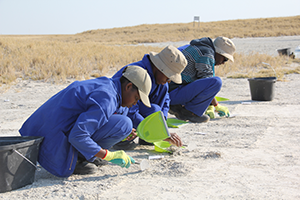
David Thomas is currently Principal Investigator on the Leverhulme Trust-funded project 'Landscape archaeology of the Kalahari: How did major hydrological shifts affect Stone Age mobility and landscape use in the late Quaternary?'. The core aim is to provide the first systematic analysis of the neglected Stone Age archaeology of the Middle Kalahari, central southern Africa, and its raw material source areas, in relation to the region's hydrological history. We are innovatively combining geochemical, field archaeological and palaeoenvironmental methods to provide the first analysis of Stone Age responses to the major hydrological changes that the Kalahari has experienced over the last ~100ka.
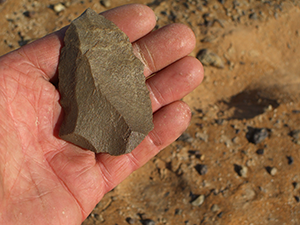
In the Thar Desert we are working with archaeologists to provide data on the nature and timing of the landscape dynamics associated with mid-Holocene Indus population changes, as part of wider assessments of both the regions complex history of monsoon dynamics and the postulated collapse of urban civilisations around 4000ka ago (Durcan and Thomas in press).
Dust- from source to sink
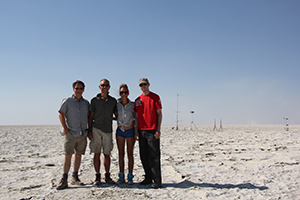
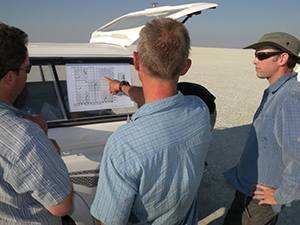
David Thomas was a Co-I on the NERC-funded DO4Models project that investigated drivers of terrestrial desert dust sources into the atmosphere, as part of a wider initiative to improve the incorporation of mineral dust components in global climate models. Engaged with the extensive field monitoring and data collection component of the project in the Makgadikgadi basin, Botswana and the dry valleys of western Namibia, the project has led to additional developments that are investigating the critical role of mineral desert dust in ocean fertilisation (Dansie , Thomas et al., submitted), and the Holocene origins and sustainability of dust sources on land (Thomas et al., 2016, submitted).
Climate change and environmental interactions with modern dryland populations
David has along track record of research into modern land degradation in drylands and its interactions with human activities (e.g. Stringer, Twyman and Thomas, 2007) and climate dynamics (Thomas, 2008), including recent work in Africa (King and Thomas, 2014) and Mongolia (e.g. Sternberg, Thomas and Middleton 2010), and that which might related environmental changes to human movements (Arnall, Thomas et al., 2013; Geddes et al., 2012).
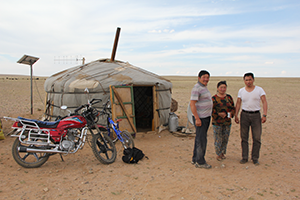
From 2002-5 he was the principal investigator on a major research project funded by the Tyndall Centre for Climate Change Research. The project investigated how natural resource-dependant societies in the developing world, particularly southern Africa, respond and adapt to climatic variability and shocks such as drought and floods, and how these responses may better inform an understanding of likely 21st century responses to global warming-induced climate change (Thomas et al., 2009). This was a truly interdisciplinary project that brought together social and environmental scientists including climate and vegetation modellers. Key outcomes included work on learning processes in adaptation, changing use of ecosystem resources, and equity and justice issues (Thomas and Twyman, 2005). A major news item was published in Nature (12 April 2007) on this research.
Interactive research
Individual research projects also feed into wider initiatives, where data are shared and analysed and where ideas and collaborations grow. David Thomas is involved with as number of international research collaborations, this also previously included leading series of successful IGCP projects. Current activities include being a key member of:
- INQUA's Dunes Atlas project that has developed an open source global digital database of chronological records of sand dune accumulation and stabilisation. Over 6000 luminescence ages have been produced from desert dune systems worldwide, creating data with the potential to explore desert responses to climate change across the globe (Lancaster, Wolfe, Thomas, et al., 2016; Thomas and Burrough, 2016).
- The Leverhulme Trust's SPAN the Atlantic programme, which initiates collaborations and shares research approaches between archaeologists and environmental scientists working in South American and southern Africa.
Selected Research Projects
- DO4 Models: Dust Observation
Funded by NERC and in collaboration with Prof. Richard Washington, Dr Giles Wiggs, the University of Sheffield and Imperial College London (2010-2014). - Floods and droughts: environmental dynamics in the Upper Zambezi Valley
Funded by The Leverhulme Trust and in collaboration with Dr Sallie Burrough and Prof. Kathy Willis (Dept. of Zoology, Oxford) (2010-2013). - Palaeolithic mega-lakes and early occupation of the Kalahari
Funded by the Boise Fund and in collaboration with Dr Sallie Burrough. - African palaeoclimate: the dating of palaeo-shoreline deposits and other geomorphic features, in Southern Africa, associated with past changes in surface hydrology
In collaboration with Dr Richard Bailey; financial support from NERC. - Detailed chronologies of aeolian system development in northern Arabia
Funded by the RGS and NERC, with Professor Andrew Goudie, Professor Adrian Parker (Oxford Brookes), Dr Richard Bailey, and postgraduates. - Tyndall: Research Programme 4: Climate change and development
In collaboration with Professor Richard Washington, Professor Kate Brown (University of East Anglia), and Dr Henny Osbahr (University of Reading); Financial support from Tyndall Centre (2006-2009). - Chronology, adaptation and environment of the Middle Palaeolithic in northern Africa.
In collaboration with Dr Geoff Duller (Aberystwyth), Libyan Palaeolake Project, Dr Simon Armitage (formerly PDRA, now lecturer at Royal Holloway); Financial support from NERC EFCHED programme; D.Phil. Students: Sallie Burrough (2002-2006).
Teaching and Supervision
Undergraduate Teaching
David teaches on Undergraduate, Masters and doctorate programmes in the School. At the undergraduate level, he lectures on the 'The Geographical Environment: Physical' core course, and contribute half of the teaching in the 'Quaternary Period' and 'Dryland Environments' Options for the Final Honour School.
Postgraduate Teaching
He delivers an MSc elective on water and civilisation.
Current Graduate Research Students
| Jasem Albanai | Remote sensing of aeolian dynamics |
| Rosie Huck | Modelling landscape response to environmental change in susceptible drylands |
| Maike Nowatzki | Exploring Morphology and Morphological Drivers of Dunefields using Deep Learning and Remote Sensing Approaches |
Recent Graduate Research Students
| Sam Woor | The evolution of Late Quaternary alluvial landscapes in northern Oman |
| Ella Walsh | Late Quaternary hydrological change from valley fill complexes in Namibia |
| Kaja Fenn | Provenance of late Quaternary loess along the middle and lower Danube River, Europe |
| Aayush Srivastava | Quaternary of the Thar Desert in India: understanding the history of dune accumulation with the aid of Optically Stimulated Luminescence (OSL) dating |
| Catherine Buckland | New methods for identifying dune system reactivation drivers and responses, Nebraska Sandhills |
| Cuthbert Makondo | Options in Climate Change Adaptation, Resilience and Mitigation: Evidence from Zambia's Rural-Rural Migration |
| Andrew Dansie | The role of windblown dust from ephemeral river valleys in the fertilisation of the Benguela Upwelling System |
| Alexandra Rowell | Sand ramps as Late Quaternary palaeoenvironmental archives: analysis from Southern Africa |
Selected Publications