
Professor Dame Sarah Whatmore
Professor of Environment and Public Policy
Fellow of Keble College, Oxford
Professor of Environment and Public Policy
Fellow of Keble College, Oxford
Academic Profile
Sarah is an elected Fellow of the British Academy, the Academy of Social Sciences and the Royal Geographical Society (with the Institute of British Geographers). In 2015 she was appointed the University's Academic Champion for Public Engagement with Research. She has served on the Council of the RGS/IBG (2004-7) and is serving as Chair of annual Conference 2015 and Vice-President 2014-2016. She is an appointed member of the Defra Science Advisory Council (SAC) (2015-20) and chairs the Council's Social Science Expert Group. Since joining Oxford to take up a Statutory Chair in Environment and Public Policy in 2004, Professor Whatmore has served as Pro Vice Chancellor for Education, the University's Academic Champion for Public Engagement with Research.
Her research focuses on cultures of nature and interrogates the ways in which human relations with the natural world are imagined and practiced in the conduct of science, governance and everyday life. She has published widely on the theoretical and political implications of these questions and is an acknowledged pioneer in what have become known as 'more-than-human' modes of enquiry, concerned with the material and ecological fabric of social life and the politics of knowledge through which this fabric is contested and re-made historically and today. Of particular interest are those situations and events in which different ecological epistemologies are brought into conflict. This informs a more recent body of work interrogating the relationship between science and democracy particularly in terms of the nature of evidence in the practices of environmental science and law and the role of expertise in environmental governance, now widely mediated by risk modelling techniques.
Her work is characterised by (i) a sustained engagement with a range of intellectual resources in philosophy, political theory and those disciplines most concerned with the study of material culture (notably cultural geography, archaeology, anthropology and science and technology studies); and (ii) a commitment to experimental and collaborative research practices that bring the different knowledge competences of social and natural scientists into play with those of diverse local publics that emerge in consequence of living with environmental risks and hazards. It has been supported by a variety of funding bodies including various UK Research Councils, NGOs and Government agencies, as well as charitable foundations such the Mellon Foundation.
These themes are brought together in her most recent books - Political Matter: Technoscience, democracy and public life (2010) (University of Minnesota Press, Minneapolis) (co-edited with Braun); Hybrid Geographies: Natures cultures spaces, 2002 (Sage, London) (2nd revised and extended edition due in 2015); Using Social Theory: Thinking through research, 2003 (Sage, London) (co-edited with Pryke and Rose); and Cultural Geography: Critical concepts, 2004 (two volumes) (Routledge, London) (co-edited with Thrift).
Current Research
Environmental Competency Groups - Developing experimental collaborative public engagement methodology trialled in RELU Environmental knowledge controversies project working with communities in the UK affected by flood risk. The Environmental knowledge controversies: science, democracy and expertise project won the RELU Programme Award for 'best example of innovation in scientific methodology'. The development project involves creating a public web-resource that enables the application of this methodology to other knowledge controversies around environmental risk management. The current development project - Making 'Competency Groups' an online public resource - is supported by a NERC Impact Accelerator Award (with Dr Catharina Landström).
- View case study on the National Co-Ordinating Centre for Public Engagement.
- View 'Stopping floods on the cheap: A success story from Yorkshire' research impact video.
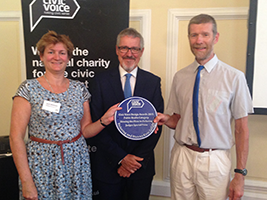
Slowing the Flow in Pickering - A collaborative research project led by Prof Sarah Whatmore has won a Judges Special Prize at the Civic Voice National Design Awards
Teaching and Supervision
Recent Graduate Research Students
| Helge Peters | More-than-rational modelling: the pragmatics and politics of social simulation in fisheries management |
| Anna Davidson | Moblizing bodies: unsettling sustainable mobility through cycling in Los Angeles |
| Rory Hill | 'Local, loyal and constant'? On the dynamism of terroir in sustainable agriculture |
Selected Publications