

Professor Heather Viles
- Professor of Biogeomorphology and Heritage Conservation
- Fellow and Tutor at Worcester College, Oxford
- Member of the Landscape Dynamics research cluster
- Tel: +44 (0)1865 285198
- Email: heather.viles@ouce.ox.ac.uk
Academic Profile
Heather Viles is a geographer with major interests in geomorphology and heritage science. Much of her research focuses on the application of science to heritage conservation. She is currently Professor of Biogeomorphology and Heritage Conservation, having previously been a University Lecturer and then Reader in the University of Oxford. She is a Fellow of Worcester College, and a lecturer at St Hilda's College. She is also an Honorary Research Fellow in the School of Geography, Archaeology and Environmental Studies, University of the Witwatersrand. She obtained an MA in Geography from the University of Cambridge, and a D.Phil. from the University of Oxford. Her D.Phil. thesis focused on the role of microorganisms in weathering limestone and was based on fieldwork on Aldabra Atoll in the Seychelles. After completing her D.Phil. she undertook post-doctoral research on the contribution of acid rain to the deterioration of English cathedrals. Heather was awarded a 650th anniversary Gold Medal, by Charles University, Prague (1998) for her contributions to international research collaboration in geomorphology.
Examples of areas where geomorphology can contribute to the understanding and conservation of cultural and natural heritage. a) Rock art on sandstone in Libya, and b) Sandstone peak forest, Zhangjiajie, China.
Over the years, Heather has carried out field-based research in NW Australia, South Africa, Namibia, Washington State, the Atacama Desert in Chile, South Germany, the Sahara Desert in Libya, as well as many places within the UK.
Setting up a 2D resistivity transect to measure moisture levels in sandstone, Golden Gate Highlands National Park, South Africa (left), and monitoring water permeate into sandstone in Belfast using a Karsten tube (above).
Currently, Heather is Deputy Chair of the British Society for Geomorphology, and will become Chair for a two year term starting in 2012. From 2008 to 2011, she was Vice-President (Expeditions and Fieldwork) of the Royal Geographical Society with IBG. She sits on the advisory panel of the £6.5 million AHRC/EPSRC Science and Heritage Programme, and was also a member of the National Heritage Science Strategy steering group co-ordinated by English Heritage and charged with developing a UK-wide Heritage Science Strategy which will shape UK-wide policy over the next 25 years. Heather also represents the University of Oxford as a trustee of the Oxford Preservation Trust. She is also an Associate Researcher at the Oxford Biodiversity Institute.
Recently, Heather has been asked to give keynote lectures at the German Geographical Congress in 2009 (where she talked about the role of physical geographers in conservation), and the 2011 Binghamton Symposium (where she will discuss the importance of microorganisms to geomorphology). She gave one of the Nigel Seeley Memorial lectures at the Bartlett School for Architecture (on greening the conservation of ruins). She is also giving (with Dr Tom Spencer, University of Cambridge) an invited talk to the 2011 Lyell Symposium at the Geological Society of London on island geomorphology. In Autumn 2011 she is taking up a three month Conservation Guest Scholarship at the Getty Conservation Institute, Los Angeles.
Current Research
Prof. Viles' research is highly interdisciplinary and involves studies at the interface of geomorphology with ecology, engineering geology, environmental chemistry and materials conservation. In recent years she has focussed on three specific themes in my research, namely:
- Biological contributions to geomorphology;
- Weathering, geomorphology and landscape evolution in extreme environments (hyper-arid, coastal, cold, and Mars); and
- Building stone decay and conservation.
She maintains a strong interest in developing and applying novel techniques and ideas to the study of these themes, including 2D resistivity surveys using Geotom equipment (with Prof. Dr Oliver Sass, University of Graz), and the Equotip hardness tester (as discussed in this recent paper). She has recently set up the Conserving Stone Heritage website which showcases some of the methods used. Heather also has a strong interest in the practical applications of 'green' methods of conserving cultural heritage (using plants, animals and microorganism communities) and linking this to biodiversity conservation.
She currently collaborates with many colleagues around the world, including Prof. Andy Whiteley (CEH, microbiology); Prof. Bernie Smith (Queen's University Belfast, geomorphology); Prof. Stefan Grab (Witwatersrand, geomorphology), Dr Phillip Fletcher (British Museum; materials conservation); Dr Mary Bourke (Planetary Science Institute, Tucson, Arizona; planetary geomorphology). Heather runs the Oxford Rock Breakdown Laboratory Group (OxRBL) which has extensive laboratory facilities and a field test site at Wytham Woods near Oxford.
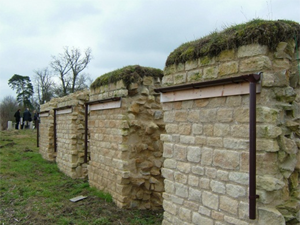
Walls built for the soft capping research project, part of OxRBL's Wytham Woods experimental field site.
In recent years her research has been funded by EPSRC, AHRC, the Leverhulme Trust, University of Oxford Fell Fund, English Heritage and NASA.
Selected Research Projects (since 2001)
- Bioprotection: an overlooked aspect of biodiversity on coastal rocks and structures
In collaboration with Dr Larissa Naylor (PI; Exeter University). Funded by the Esmee Fairbairn Trust (2011-2013) - Integrated surface hardness and ultrasonic pulse velocity testing for the non-destructive diagnosis of deterioration problems on sandstone and limestone cultural heritage
Funded by Proceq (2011-2014) - Climate change and the greening of masonry: implications for built heritage and new build
In collaboration with Prof. Bernie Smith (Queen's University Belfast) and Prof. Andy Whiteley (CEH). Funded by EPSRC (2009-2012) - Back to nature: geologically-informed consolidation techniques for conserving stone artefacts in museum collections
Funded by AHRC (Collaborative Doctoral Award with British Museum) (2009-2012) - Rock Breakdown on Earth and Mars
In collaboration with Dr Mary C. Bourke and B. Ehlmann. Funded by NASA Planetary Geology and Geophysics Program (2004-2012) - Soft wall capping as a conservation method for ruined monuments
In collaboration with Chris Wood (English Heritage), Alan Cathersides (English Heritage) and Colin Burns (Consultant). Funded by English Heritage (2004-2011) - Damp Towers: understanding moisture penetration and damp problems in deteriorating walls
In collaboration with Dr Liz Laycock (Sheffield Hallam University) and Chris Wood (English Heritage). Funded by English Heritage; (2004-2011) - Climate change, moisture regimes and deterioration of stone monoliths
In collaboration with Prof. Chris Hall, Materials Science, University of Edinburgh. Funded by the Leverhulme Trust (2007-2011) - Ivy on walls
In collaboration with Alan Cathersides (English Heritage). Funded by English Heritage (2006-2010) - Consensus or collision?: Integrating methods for the study of the historic environment (research cluster)
In collaboration with Dr Dan Hicks (University of Bristol) and Dr David Harvey (University of Exeter). Funded by EPSRC (2006-2007) - Rapid, catastrophic deterioration of building limestone
In collaboration with Prof. Bernie Smith (Queen's University Belfast) and Prof. Ken Grattan (City University London). Funded by EPSRC (2006-2009)
Teaching
Prof. Viles was Director of Undergraduate Studies from 2008-2011, during which time the department completely revised its undergraduate course. She contributes to the Geomorphology lecture course of the Earth System Processes core course for Prelims, as well as to the Environmental Geography and Earth System Dynamics courses in the Final Honour School. She also convenes the Heritage science and conservation option.
Heather welcomes applications from students wishing to undertake graduate research in any aspect of biogeomorphology and heritage conservation.
Current graduate students include:
- Samin Ahmad
Green walls: microbiology of algae growing on sandstone walls and implications for the impacts of climate change on cultural heritage - Jennifer Booth
'Back to Nature'? Geologically informed consolidation techniques for conserving stone artefacts in museum collections - Cristina Cabello Briones
Preventative conservation of archaeological sites. Strategies to reduce the impact of climate change on exposed archaeological remains: reburial and shelters - Shuaishuai He
Heritage conservation and urban revitalization in China: applying for World Heritage listing for the Grand Canal, conserving canal heritage, and revitalizing canal cities - Noreen Zaman
The role of soil as a method for conserving cultural stone ruins: effects of physical and chemical characteristics on stone weathering
D.Phil. students successfully completing since 2001:
- Lisa Mol (2011)
Sandstone weathering, electrical resistivity tomography, and the deterioration of San rock art in the Golden Gate Highlands National Park, South Africa - Abigail Stone (2009)
Multi-proxy reconstruction of late Quaternary climate dynamics in western Southern Africa. - Bethany Ehlmann (2007)
Developing quantitative techniques for evaluating rock breakdown morphology: a case study of basalt boulders in the channelled scablands, Washington, USA - Mary Thornbush (2005)
Traffic pollution and urban limestone weathering: central Oxford, England. - Nicholas Carter (2002)
Bioprotection, species richness and landscape aesthetics: On the contribution of lichens to architectural heritage conservation. - Larissa Naylor (2001)
Biogeomorphological responses of rocky coasts in South Wales, UK and Western Crete, Greece.
- Satish Pandey (2010) (RLAHA)
Dynamics of the transport, distribution and crystallisation of soluble salts in sandstone: implications for conservation of historic buildings.
Selected Publications
Books
Goudie, A.S. and Viles, H.A. (2010) Landscapes and Geomorphology: A very short introduction. Oxford University Press, 144 pp. ISBN-10: 0199565570.
Rogers, A. and Viles, H.A. (eds.) (2003) The student's companion to geography. 2nd edition. Oxford; Blackwell.
Prikryl, R. and Viles, H.A. (eds.) (2002) Understanding and managing stone decay. The Karolinum Press; Prague.
Goudie, A.S. and Viles, H.A. (1997) Salt Weathering Hazards. Wiley. pp. 256.
H.A. Viles and T. Spencer (1995) Coastal Problems: Geomorphology, Ecology and Society at the Coast. Hodder Arnold. pp. 360.
Edited Volumes
- Smith, B.J., Gomez-Heras, M., Viles, H.A. and Cassar, J. (eds.) (2010) Limestone in the Built Environment: Present-day Challenges for the Preservation of the Past. Geological Society, Special Pub., 331. ISBN 9781862392946.
- Siegesmund, S., Viles, H.A. and Weiss, T. (2004) Stone decay hazards. Environmental Geology Special Issue, 46(3-4): 303-526.
- Viles, H.A. and Wild, L.S. (guest editors) (2003) Building Stone Decay: Observations, Experiments and Modeling. Building and Environment, 38(9-10): 1089-1260.
- Viles, H.A. and Naylor, L.A. (guest editors) (2002) Biogeomorphology special issue. Geomorphology, 47(1): 1-94.
Papers and Articles
- Arizzi, A., Viles, H. and Cultrone, G. (2012) Experimental testing of the durability of lime-based mortars used for rendering historic buildings. Construction and Building Materials, 28(1): 807-818.
- Viles, H.A. and Goudie, A.S. (2012) Weathering in the central Namib Desert, Namibia: controls, processes and implications. Journal of Arid Environments.
- Eklund, J.A., Zhang, H., Viles, H.A. and Curteis, T. (2011) Using hand-held moisture meters on limestone: some factors affecting their performance and guidelines for best practice. International Journal of Architectural Heritage.
- Hall, C., Hamilton, A., Hoff, W.D. Viles, H.A. and Eklund, J.A. (2011) Moisture dynamics in walls: response to micro-environment and climate change. Proceedings of the Royal Society, 467(2125): 194-211.
- Mol, L. and Viles, H.A. (2011) The role of rock surface hardness and internal moisture in tafoni development in sandstone. Earth Surface Processes and Landforms.
- Naylor, L.A., Coombes, M.A. and Viles, H.A. (2011) Reconceptualising the role of organisms in the erosion of rock coasts: a new model. Geomorphology.
- Smith, B.J., Srinivasan, S., McCabe, S., McAllister, D., Cutler, N.A., Basheer, P.A.M. and Viles, H.A. (2011) Climate change and the investigation of complex moisture regimes in heritage stone: preliminary observations on possible strategies. Materials Evaluation, 69(1): 48-58.
- Viles, H.A. (2011) Microbial geomorphology: A neglected link between life and landscape. Geomorphology.
- Viles, H.A. (2011) Physical geography in a changing world: helping to integrate conservation of cultural heritage, geodiversity and biodiversity. Chapter 1 in, Fassmann, H. and Glade, T. (eds.) Geographie für eine Welt im Wandel. Vienna University Press. 15pp. ISBN 978-3-89971-912-3.
- Viles, H.A. (2011) Biogeomorphology. In, Gregory, K.J. and Goudie, A.S. (eds.) (2011) The SAGE Handbook of Geomorphology, SAGE. pp. 246-259. ISBN: 9781412929059.
- Viles, H.A. (2011) Weathering systems. Chapter 6 in, Thomas, D.S.G. (ed.) (2011) Arid Zone Geomorphology: Process, Form and Change in Drylands, 3rd Edition. Wiley, 648 pp. ISBN: 9780470519080.
- Viles, H.A., Sternberg, T. and Cathersides, A. (2011) Is ivy good or bad for historic walls? Journal of Architectural Conservation, 17(2): 21-41.
- Cutler, N. and Viles, H.A. (2010) Eukaryotic microorganisms and stone biodeterioration. Geomicrobiology Journal, 27(6): 630-646.
- Gomez-Heras, M., Smith, B.J. and Viles, H.A. (2010) Oxford stone revisited. Chapter 10 in, Prikryl, R. (ed.) Natural Stone Resources for Historical Monuments. Geological Society, Special Pub., 333. pp. 101-110, ISBN: 9781862392915.
- Mol, L. and Viles, H.A. (2010) Geoelectric investigations into sandstone moisture regimes: Implications for rock weathering and the deterioration of San Rock Art in the Golden Gate Reserve, South Africa. Geomorphology.
- Sass, O. and Viles, H.A. (2010) Wetting and drying of masonry walls: 2D-resistivity monitoring of driving rain experiments on historic stonework in Oxford, UK. Journal of Applied Geophysics, 70: 72-83.
- Sass, O. and Viles, H.A. (2010) Two-dimensional resistivity surveys of the moisture contents of historic limestone walls in Oxford, UK: implications for understanding catastrophic stone deterioration. Chapter 22 in, Limestone in the Built Environment: Present-day Challenges for the Preservation of the Past. Geological Society, Special Pub. 331. pp. 237-250. ISBN 9781862392946.
- Smith, B.J., Gomez-Heras, M. and Viles, H.A. (2010) Underlying issues on the selection, use and conservation of building limestone. Chapter 1 in, Limestone in the Built Environment: Present-day Challenges for the Preservation of the Past. Geological Society, Special Pub. 331. pp. 1-13. ISBN 9781862392946.
- Sternberg, T., Viles, H.A. and Cathersides, A. (2010) Evaluating the role of ivy (Hedera helix) in moderating wall surface microclimates and contributing to the bioprotection of historic buildings. Building and Environment, 46(2): 293-297.
- Sternberg. T., Viles H.A., Cathersides, A. and Edwards, M. (2010) Dust particulate absorption by ivy (Hedera helix L) on historic walls in urban environments. Science of the Total Environment, 409(1): 162-168.
- Stone, A.E.C., Thomas, D.S.G. and Viles, H.A. (2010) Late Quaternary palaeohydrological changes in the northern Namib Sand Sea: New chronologies using OSL dating of interdigitated aeolian and water-lain interdune deposits. Palaeogeography, Palaeoclimatology, Palaeoecology, 288(1-4): 35-53.
- Stone, A.E.C., Viles, H.A., Thomas, L. and van Calsteren, P. (2010) Can 234U-230Th dating be used to date large semi-arid tufas? Challenges from a study in the Naukluft Mountains, Namibia. Journal of Quaternary Science, 25(8): 1360-1372.
- Smith, B.J., McCabe, S., McAllister, D., Adamson, C., Viles, H.A. and Curran. J.M. (2010) A commentary on climate change, stone decay dynamics and the 'greening' of natural stone buildings: new perspectives on 'deep wetting'. Environmental Earth Sciences.
- Viles, H.A., Ehlmann, B., Wilson, C.F., Cebula, T., Page, M., and Bourke, M. (2010) Simulating weathering of basalt on Mars and Earth by thermal cycling. Geophysical Research Letters, 37: L18201.
- Viles, H.A., Goudie, A.S., Grab, S. and Lalley, J. (2010) The use of the Schmidt Hammer and Equotip for rock hardness assessment in geomorphology and heritage science: a comparative analysis. Earth Surface Processes and Landforms.
- Bourke, M., Viles, H.A., Nicoli, J., Lyew-Ayee, P., Ghent, R., and Holmlund, J. (2008) Innovative applications of laser scanning and rapid prototype printing to rock breakdown experiments. Earth Surface Processes and Landforms, 33(10): 1614-1621.
- Ehlmann, B.L., Viles, H.A. and Bourke, M.C. (2008) Quantitative morphologic analysis of boulder shape and surface texture to infer environmental history: A case study of rock breakdown at the Ephrata Fan, Channeled Scabland, Washington. Journal of Geophysical Research, 113: FO2012.
- Viles, H.A. (2008) Understanding dryland landscape dynamics: Do biological crusts hold the key? Geography Compass, 2.
- Viles, H.A., Naylor, L.A., Carter, N.E. and Chaput, D. (2008) Biogeomorphological disturbance regimes: progress in linking ecological and geomorphological systems. Earth Surface Processes and Landforms, 33(9): 1419-1435.
- Viles, H.A. and Pentecost, A. (2007) Tufa and travertine. Chapter 6 in, Nash, D.J. and McLaren, S.J. (eds.) Geochemical Sediments and Landscapes. Blackwell Publishing.
- Viles, H.A. and Goudie, A.S. (2007) Rapid salt weathering in the coastal Namib Desert: Implications for landscape development. Geomorphology, 85: 49-62.
- Viles, H.A., Taylor, M.P., Nicoll, K.N. and Neumann, S. (2007) Facies evidence of hydroclimatic regime shifts in tufa depositional sequences from the arid Naukluft Mountains, Namibia. Sedimentary Geology, 195: 39-53.
- Thornbush, M.J. and Viles, H.A. (2007) Simulation of the dissolution of weathered and unweathered limestone in carbonic acid solutions of varying strength. Earth Surface Processes and Landforms, 32: 841-852.
- Viles, H.A. and Wood, C. (2007) Green walls? Integrated laboratory and field testing fo the effectiveness of soft wall capping in conserving ruins. In, Prikryl, R. and Smith, B.J. (eds.) Building stone decay: from diagnosis to conservation. Geological Society Special Publication, 271: 309-322.
- Thornbush. M.J. and Viles, H.A. (2007) Photo-based decay mapping of replaced stone blocks on the boundary wall of Worcester College, Oxford. In, Prikryl, R. and Smith, B.J. (eds.) Building stone decay: from diagnosis to conservation. Geological Society Special Publication, 271: 69-75.
- Thornbush, M.J. and Viles, H.A. (2006) Changing patterns of soiling and microbial growth on building stone in Oxford, England after implementation of a major traffic scheme. Science of the Total Environment, 367: 203-211.
- Lalley, J.S. and Viles, H.A. (2006) Do vehicle track disturbances affect the productivity of soil-growing lichens in a fog desert? Functional Ecology, 20: 548-556.
- Lalley, J.S., Viles, H.A., Henschel, J.R. and Lalley, V. (2006) Lichen-dominated soil crusts as arthropod habitat in warm deserts. Journal of Arid Environments, 67: 579-593.
- Smith, B.J. and Viles, H.A. (2006) Rapid, catastrophic decay of building limestones: Thoughts on causes, effects and consequences. In, Fort, R. et al (eds.) Heritage, weathering and conservation. Taylor and Francis, London. pp. 191-198.
- Thornbush, M.J. and Viles, H.A. (2006) Use of portable X-ray fluorescence for monitoring elemental concentrations in surface units on roadside stone at Worcester College, Oxford. In, Fort, R. et al (eds.) Heritage, weathering and conservation. Taylor and Francis, London. pp. 613-620.
- Sass, O. and Viles, H.A. (2006) How wet are these walls? Testing a novel technique for measuring moisture in ruined walls. Journal of Cultural Heritage, 7: 257-263.
- Thornbush, M.J. and Viles, H.A. (2005) The changing façade of Magdalen College, Oxford: Reconstructing long-term soiling patterns from archival records and traffic records. Journal of Architectural Conservation, 11.
- Viles, H.A. (2005) Self-organized or disorganized? Towards a general explanation of cavernous weathering. Earth Surface Processes and Landforms, 30: 1471-1473.
- Viles, H.A. (2005) A divided discipline? In, Castree, N. Rogers, A. and Sherman, D. (eds.) Questioning Geography. Oxford: Blackwell.
- Viles, H.A. (2005) Can stone decay be chaotic? In, Turkington, A.V. (ed.) GSA Special Publication, Stone Decay in the Architectural Environment. pp. 11-16.
- Viles, H.A. (2005) Microclimate and weathering in the central Namib Desert. Geomorphology, 67: 189-209.
- Carter, N.E.A. and Viles, H.A. (2005) Bioprotection explored: the story of a little known earth surface process. Geomorphology, 67: 273-281.
- Viles, H.A., Brearley, A.J., Bourke, M. and Holmlund, J. (2005) What processes have shaped basalt boulders on Earth and Mars? Studies of feature persistence using facet mapping and fractal analysis. Lunar and Planetary Science Conference XXXVI, Abstract No. 2237.pdf
- Lalley, J.S. and Viles, H.A. (2005) Terricolous lichens in the Northern Namib desert of Namibia: distribution and community composition. The Lichenologist, 37: 77-91.
- Carter, N.E.A. and Viles, H.A. (2004) Lichen hotspots: raised rock temperatures beneath Verrucaria nigrescens on limestone. Geomorphology, 62: 1-16.
- Viles, H.A. and Goudie, A.S. (2004) Biofilms and case hardening on sandstones from Al-Quwayra, Jordan. Earth Surface Processes and Landforms, 29: 1473-1485.
- Heslop, E.E.M., Viles, H.A. and Bourke, M.C. (2004) Understanding rock breakdown on Earth and Mars: Geomorphological concepts and facet mapping methods. Lunar and Planetary Science Conference XXXV, Abstract No. 1445.pdf
- Mottershead, D.N. and Viles, H.A. (2004) Experimental studies of rock weathering by plant roots: Updating the work of Julius Sachs (1832-1897). In, Mitchell, D.J. and Searle, D.E. (eds.) Stone deterioration in polluted urban environments. Science Publishers Inc; Plymouth, UK.
- Mulla, E. and Viles, H.A. (2004) A review of the impact of NO2 on stone decay and the relationship found between NO2 concentration and stone soiling rate in a case study in Oxford. The Albanian Journal of Natural and Technical Sciences, 16: 71-80.
- Thornbush, M. and Viles, H.A. (2004) Integrated digital photography and image processing for the quantification of colouration on soiled limestone surfaces in Oxford, England. Journal of Cultural Heritage, 5: 285-290.
- Thornbush, M.J. and Viles, H.A. (2004) Surface soiling patterns detected by integrated digital photography and image processing on exposed limestone in Oxford, England. In, Saiz-Jimenez, C. (ed.) Air pollution and cultural heritage. London: Taylor and Francis. pp. 221-224.
- Viles, H.A. and Goudie, A.S. (2003) Interannual, decadal and multidecadal scale climatic variability and geomorphology. Earth Science Reviews, 61: 105-131.
- Viles, H.A. (2003) Conceptual modelling of the impacts of climate change on karst geomorphology in the UK and Ireland. Journal for Nature Conservation, 11: 59-66.
- Viles, H.A. (2003) 'The writing's on the walls': On style, substance and selling physical geography. In, Trudgill, S.T. and Roy, A. (eds.) Contemporary meanings in physical geography. London: Edward Arnold.
- Viles, H.A. and Gorbushina, A.A. (2003) Soiling and microbial colonization on urban roadside limestone: A three year study in Oxford, England. Building and Environment, 38: 1217-1224.
- Turkington, A.V., Martin, E., Viles, H.A. and Smith, B.J. (2003) Surface change and decay of sandstone samples exposed to a polluted urban atmosphere over a six-year period: Belfast, Northern Ireland. Building and Environment, 38: 1205-1216.
- Carter, N.E.A. and Viles, H.A. (2003) Experimental investigations into the interactions between moisture, rock surface temperatures and an epilithic lichen cover in the bioprotection of limestone. Building and Environment, 38: 1225-1234.
- Antill, S.J. and Viles, H.A. (2003) Examples of the use of computer simulation as a tool for stone weathering research. Building and Environment, 38: 1243-1250.
- Thompson, M., Wilkins, S.J., Compton, R.G. and Viles, H.A. (2003) Channel flow cell studies on the evaluation of surface pretreatments using phosphoric acid or polymaleic acid for calcite stone protection. Journal of Colloid and Interface Science, 259: 338-345.
- Thompson, M., Wilkins, S.J., Compton, R.G. and Viles, H.A. (2003) Polymer coatings to passivate calcite from acid attack: polyacrylic acid and polyacrylonitrile. Journal of Colloid and Interface Science, 260: 204-210.
- Viles, H.A. (2002) Implications of future climate change for stone deterioration. In, Siegesmund, S., Vollbrecht, S.A. and Weiss, T. (eds.) Natural stone, weathering phenomena, conservation strategies and case studies. Special Publication 205, Geological Society of London. pp. 407-418.
- Naylor, L.A., Viles, H.A., and Carter, N.E.A. (2002) Biogeomorphology revisited: Looking towards the future. Geomorphology, 47: 3-14.
- Naylor, L.A. and Viles, H.A. (2002) A new technique for evaluating short-term rates of coastal bioerosion and bioprotection. Geomorphology, 47: 31-44.
- Viles, H.A., Taylor, M.P., Yates, T.J.S. and Massey, S.W. (2002) Soiling and decay of NMEP limestone tablets. Science of the Total Environment, 292: 215-229.
- Viles, H.A., Groves, C. and Wood, C. (2002) Soft wall capping experiments. In, John Fidler (ed.) English Heritage Research Transactions, Stone, 2: 59-73.
- Wilkins, S.J., Compton, R.G., Viles, H.A. and Taylor, M.P. (2002) A new technique to evaluate and quantify modified solution kinetics of calcareous materials after sulfuric acid pre-treatment and urban exposure. Studies in Conservation, 47: 88-94.
- Stretch, R. and Viles, H.A. (2002) Lichen weathering on Lanzarote lava flows. Geomorphology, 47: 87-94.
- Goudie, A.S., Wright, E. and Viles, H.A. (2002) An experimental investigation of the roles of salt (sodium nitrate) and fog in weathering: the northern Atacama Desert, Chile. Catena, 48: 255-266.
- Spencer, T. and Viles, H.A. (2002) Bioconstruction, bioerosion and disturbance on coral reefs and rocky carbonate coasts. Geomorphology, 48: 23-50.
- Wilkins, S.J., Compton, R.G., Taylor, M.A. and Viles, H.A. (2001) Channel flow cell studies of the inhibiting action of gypsum on the dissolution kinetics of calcite: A laboratory approach with implications for field monitoring. Journal of Colloid and Interface Science, 236: 354-361.
- Wilkins, S.J., Compton, R.G. and Viles, H.A. (2001) The effect of surface pre-treatment with polymaleic acid, phosphoric acid or oxalic acid on the dissolution kinetics of calcium carbonate in aqueous acid. Journal of Colloid and Interface Science, 242: 378-385.
- Trudgill, S.T., Viles, H.A., Inkpen, R.J., Moses, C.A., Gosling, W., Yates, T., Collier, P., Smith, D.I. and Cooke, R.Y. (2001) Twenty year remeasurements at St Paul's Cathedral, London. Earth Surface Processes and Landforms, 26: 1129-1142.
- Viles, H.A. (2001) Scale issues in weathering studies. Geomorphology, 41: 63-72.