New SoGE-led research project to investigate drivers of hidden savanna vegetation change

A new NERC-funded project, led by SoGE researcher Dr Nicola Stevens, will explore how fire and herbivory affect tree architecture and reproduction in African savannas.
Fire and large herbivores are key to maintaining the rich biodiversity of African savannas. They also shape tree architecture - the arrangement of trunks, branches and crowns - with potentially important consequences for flowering and seed production.
TRASE (Tree Reproduction and Architecture in Savanna Ecosystems) will combine field ecology and detailed 3D models of trees and shrubs to investigate how architecture influences reproductive capacity. The team will then use AI and remote sensing to scale these findings across landscapes, helping predict which tree species can sustain their populations under different disturbance regimes.
Working in South Africa’s Kruger National Park, the researchers will draw on long-term fire and herbivory experiments. Their findings will inform the management of fire, herbivores and savanna biodiversity.
TRASE is funded by the Natural Environment Research Council (NERC) through its Pushing the Frontiers programme. The project brings together Nicola Stevens and Sruthi K. M. Parvathi at Oxford, Andrew Davies at Harvard University, and collaborators at South African National Parks (SANParks).
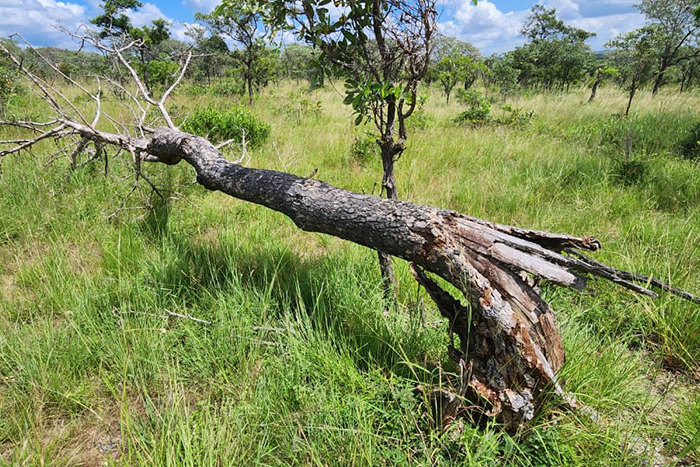
A tree knocked over by an elephant (c) Dr Nicola Stevens
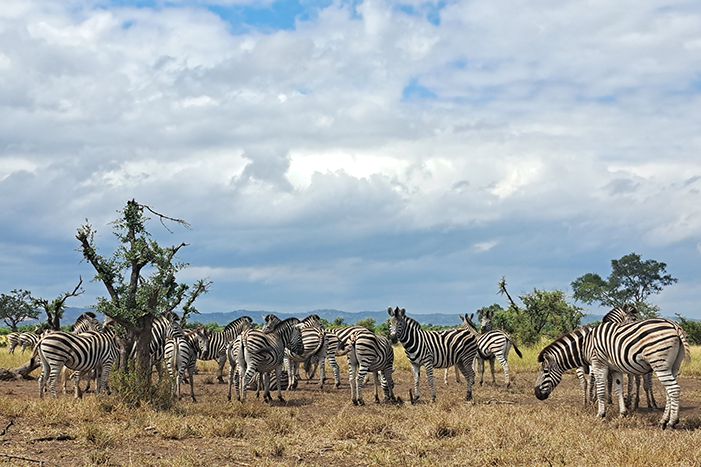
Trees pruned by animals (c) Dr Nicola Stevens
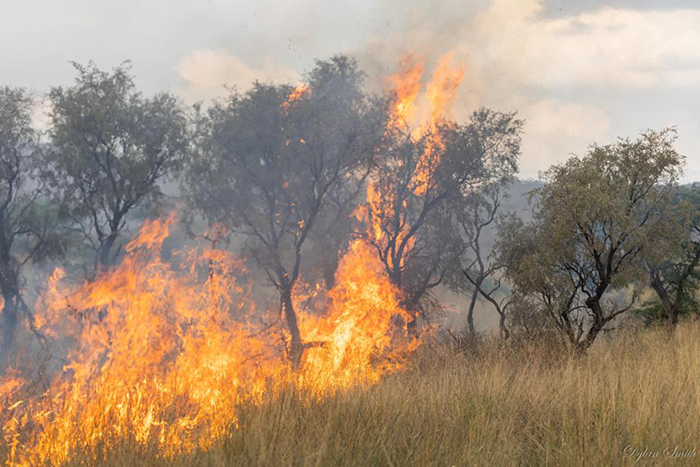
Fire in the savanna (c) Dr Nicola Stevens
Main image: Elephants - the primary agent of change for trees in savannas. (c) Dr Nicola Stevens.
New SoGE-led research project to investigate drivers of hidden savanna vegetation change
A new NERC-funded project, led by SoGE researcher Dr Nicola Stevens, will explore how fire and herbivory affect tree architecture and reproduction in African savannas.